Communities at Crossroads in Cyberculture
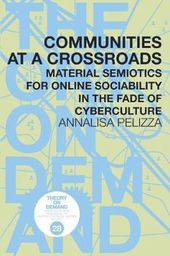
How should we understand and discuss online culture and communities in the 21st century? To answer this question, Annalisa Pelizza looks back at the mid-2000s in her new book Communities at a Crossroads. In this event Pelizza will discuss her findings together with Stefania Milan and the audience.
The mid-2000s were a turning point for digital communitarian cultures, with the burst of the creative-entrepreneur alliance, the territorialization of the internet and the commercialization of interpersonal ties. Up until then, ideas for online sociability had been underpinned by the utopian perspectives of a techno-libertarian culture. However, these ideas began to face systematic counter evidence in the mid-2000s, causing a change of paradigm that has consequences to this very day.
Annalisa Pelizza investigates the theories of actions supporting the techno-social digital assemblages that developed after the ‘golden age’ of online communities. In doing so, Pelizza avoids both empty invocations of community and swift conclusions of doom. Instead, Communities at Crossroads presents a multi-faceted picture of internet sociability between the two centuries. In her book, Pelizza draws upon the analysis of Ars Electronica’s Digital Communities archive, the largest of its kind worldwide.
About the speakers
Annalisa Pelizza is Associate Professor of Science and Technology Studies (STS) at the University of Twente, where she leads the ERC-funded Processing Citizenship research group . Her research lies at the intersection of STS, communication science and political theory, with a focus on governance by data infrastructures. Annalisa was active in digital communities (such as Telestreet network of community broadcasters). She worked as media art producer and designer and developed large-scale IT infrastructures.
John D. Boy is an assistant professor of sociology at Leiden University. With interests informed by classical sociological thought and cultural theory, his current research preoccupation is social media and how they reconfigure sociality and space in cities. Boy will connect the ideas from the book to the broader field of sociology.
Stefania Milan is Associate Professor of New Media at the University of Amsterdam. Her work explores the intersection of digital technology, governance and activism, with emphasis on critical data practices and autonomous infrastructure. She is the author of Social Movements and Their Technologies: Wiring Social Change (2011).
:rgb(-15,-3,-18)/https://admin.spui25.nl/wp-content/uploads/2026/02/nahrizul-kadri-OAsF0QMRWlA-unsplash.jpg)

:rgb(-25,-2,1)/https://admin.spui25.nl/wp-content/uploads/2025/10/conspiracy.png)

:rgb(8,-11,-35)/https://admin.spui25.nl/wp-content/uploads/2025/09/sola-boon-mediumres.jpg)
